

OpenPrescribing Newsletter: April 2018
- Posted:
- Written by:
- Categories:

This post is part of a series: OpenPrescribing Newsletters
- OpenPrescribing Newsletter: Autumn 2026
- OpenPrescribing Newsletter: Spring 2026
- OpenPrescribing Newsletter: October 2025
- OpenPrescribing Newsletter: Autumn 2025
- OpenPrescribing Newsletter: August 2025
- OpenPrescribing Newsletter: Autumn 2024
- OpenPrescribing Newsletter: Summer 2024
- OpenPrescribing Newsletter: Spring 2024
- OpenPrescribing Newsletter: Winter 2024
- OpenPrescribing Newsletter: Autumn 2023
- OpenPrescribing Newsletter: June 2022
- OpenPrescribing Newsletter: December 2021
- OpenPrescribing Newsletter: March 2021
- OpenPrescribing Newsletter: November 2020
- OpenPrescribing Newsletter: July 2020
- OpenPrescribing Newsletter: June 2020
- OpenPrescribing Newsletter: May 2020
- OpenPrescribing Newsletter: November 2019
- OpenPrescribing Newsletter: October 2019
- OpenPrescribing Newsletter: September 2019
- OpenPrescribing Newsletter: Summer 2019
- OpenPrescribing Newsletter: June 2019
- OpenPrescribing Newsletter: May 2019
- OpenPrescribing Newsletter: February 2019
- OpenPrescribing Newsletter: December 2018
- OpenPrescribing Newsletter: October 2018
- OpenPrescribing Newsletter: July 2018
- OpenPrescribing Newsletter: June 2018
- OpenPrescribing Newsletter: May 2018
- OpenPrescribing Newsletter: April 2018
- OpenPrescribing Newsletter: March 2018
- OpenPrescribing Newsletter: February 2018
- OpenPrescribing Newsletter: January 2018
- OpenPrescribing Newsletter: December 2017
- OpenPrescribing Newsletter: November 2017
- OpenPrescribing Newsletter: October 2017
Homeopathy Paper Published
Our new paper asks the question: Is use of homeopathy associated with poor prescribing in English primary care? The answer, yes. We found that general practices that have worse than average prescribing scores on our standard measures were more than twice as likely to prescribe homeopathy than practices with better than average scores. Interestingly, the level of homeopathy prescribing we found is quite low and is decreasing quite quickly.
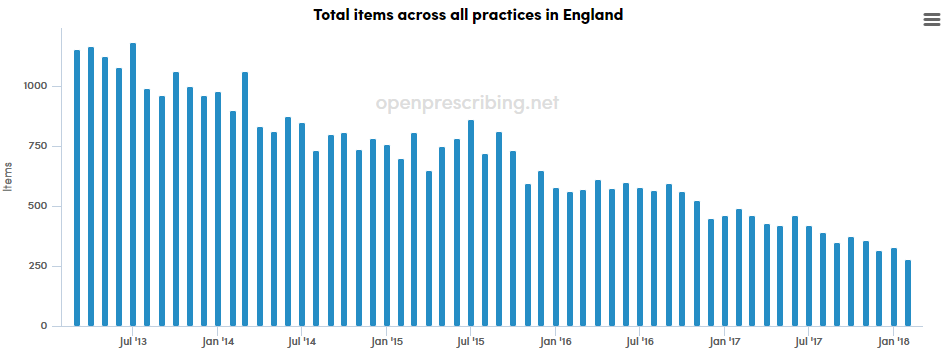
You can find out more about this by reading the paper, which has also picked up some press coverage in New Scientist, The Times, Pulse and Daily Mail.
Gluten-Free Prescribing Paper
Our paper on gluten-free food prescribing and its variation across practices and CCGs has now been published in BMJ Open. It was covered in medical news articles in the BMJ and Pulse, among others, and by the charity Coeliac UK.
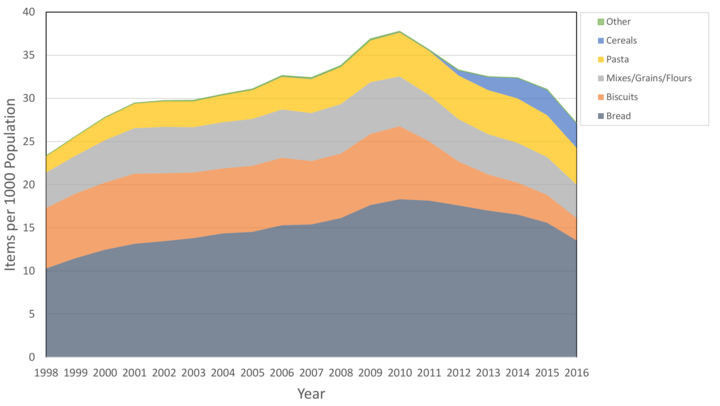
You can also read more in our blog.
User tip - The Analyse Page
You can use the Analyse page to investigate variation and trends in any selected part of the BNF, right down to the level of individual presentations. Data can be viewed for all CCGs, with selected CCGs highlighted, or for all practices in your selected CCGs. You can click the play button to watch how the trends change over time, and also download the data. You can find more detail on how to use this tool in our FAQ, including how to choose the right denominators.
Prescribing data update
We"ve updated OpenPrescribing with February’s data. Head over to www.openprescribing.net to see more.
In other news…
Unreported Trial of the Week
Following the launch of our FDAAA TrialsTracker, we have begun writing a series for the BMJ, “Unreported Trial of the Week”
Each week we profile a new unreported clinical trial that has not reported results in accordance with their legal requirements. You can see all four trials we have profiled thus far as well as the introductory post at the BMJ. A short summary and a link to each of the first four trials is provided in our blog.
Sign up
You can sign up to receive the newsletter on www.openprescribing.net