


OpenPrescribing Newsletter: Summer 2024
- Posted:
- Written by:
- Categories:

This post is part of a series: OpenPrescribing Newsletters
- OpenPrescribing Newsletter: Autumn 2026
- OpenPrescribing Newsletter: Spring 2026
- OpenPrescribing Newsletter: October 2025
- OpenPrescribing Newsletter: Autumn 2025
- OpenPrescribing Newsletter: August 2025
- OpenPrescribing Newsletter: Autumn 2024
- OpenPrescribing Newsletter: Summer 2024
- OpenPrescribing Newsletter: Spring 2024
- OpenPrescribing Newsletter: Winter 2024
- OpenPrescribing Newsletter: Autumn 2023
- OpenPrescribing Newsletter: June 2022
- OpenPrescribing Newsletter: December 2021
- OpenPrescribing Newsletter: March 2021
- OpenPrescribing Newsletter: November 2020
- OpenPrescribing Newsletter: July 2020
- OpenPrescribing Newsletter: June 2020
- OpenPrescribing Newsletter: May 2020
- OpenPrescribing Newsletter: November 2019
- OpenPrescribing Newsletter: October 2019
- OpenPrescribing Newsletter: September 2019
- OpenPrescribing Newsletter: Summer 2019
- OpenPrescribing Newsletter: June 2019
- OpenPrescribing Newsletter: May 2019
- OpenPrescribing Newsletter: February 2019
- OpenPrescribing Newsletter: December 2018
- OpenPrescribing Newsletter: October 2018
- OpenPrescribing Newsletter: July 2018
- OpenPrescribing Newsletter: June 2018
- OpenPrescribing Newsletter: May 2018
- OpenPrescribing Newsletter: April 2018
- OpenPrescribing Newsletter: March 2018
- OpenPrescribing Newsletter: February 2018
- OpenPrescribing Newsletter: January 2018
- OpenPrescribing Newsletter: December 2017
- OpenPrescribing Newsletter: November 2017
- OpenPrescribing Newsletter: October 2017
You can sign up for email versions of this newsletter here.
Sign up for our free OpenPrescribing webinars
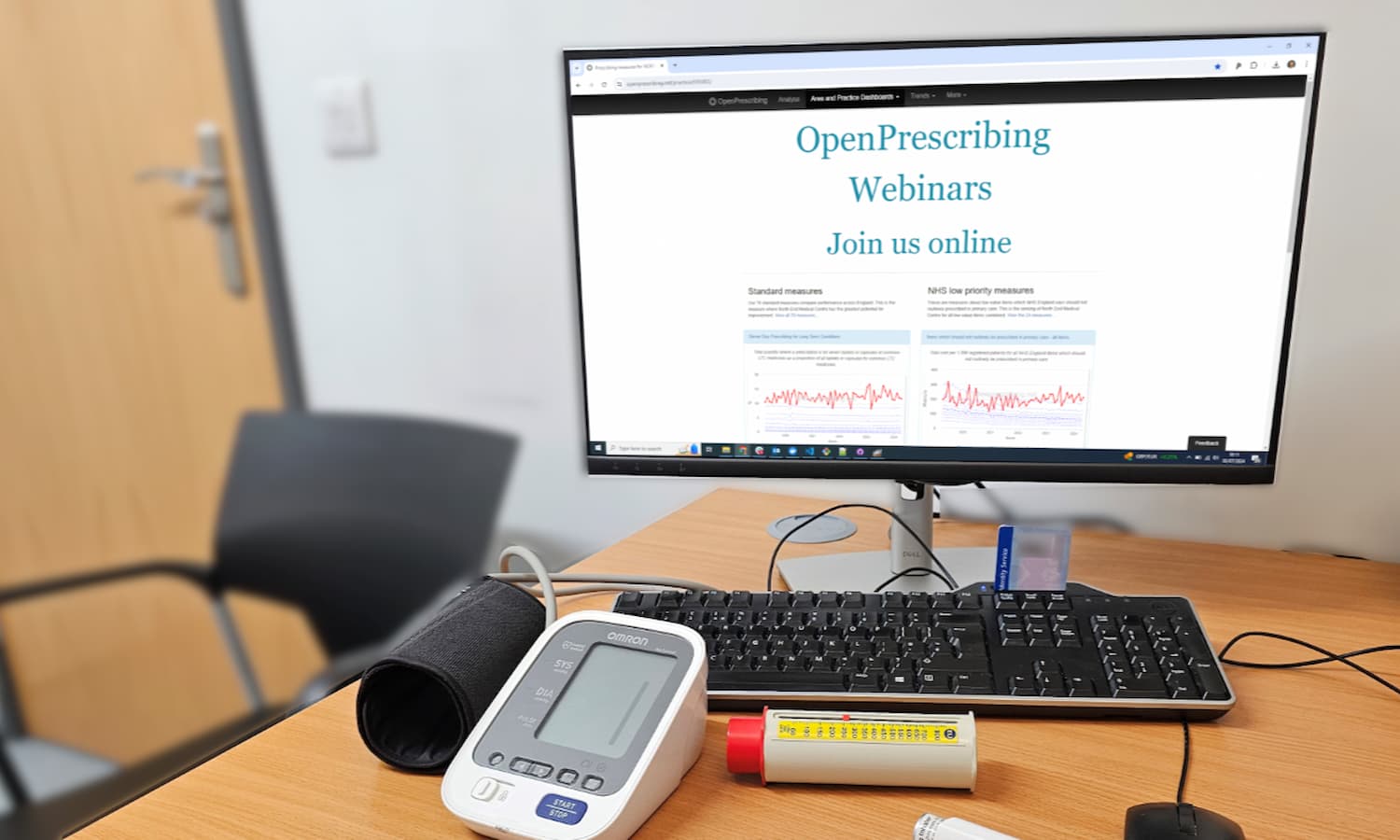
Over the next few months, we’re going to be hosting a series of webinars to showcase the ins and outs of OpenPrescribing. They’ll cover the main features of OpenPrescribing, including the measures we provide and details of how to conduct your own analyses. We will also explore additional OpenPrescribing tools and provide practical tips to help you get the most out of OpenPrescribing.
We’ll be running different sessions for different groups, so whether you work in healthcare, or you’re simply interested in understanding how to use OpenPrescribing, there will be a session that suits you.
See this page to book your spot.
Planned removal of STAR-PUs from OpenPrescribing
Thank you to all those who have sent in comments about STAR-PUs following recent mentions in our newsletter and blog. Based on the feedback we have received so far, the majority of our users seem to be in favour of removing STAR-PUs as a denominator from OpenPrescribing. We therefore plan to gradually phase out STAR-PUs as a denominator in measures and as an option on the analyse page over the coming months.
💬 But it’s not too late to let us know your thoughts! Please tell us what you think about this topic by emailing us at bennett@phc.ox.ac.uk or posting on X at @OpenPrescribing. Do you still use STAR-PUs? How confident do you feel about their validity? What alternatives do you think are better?
Excess quantity of pens measure updated
Following the recent launch of tirzepatide in a multidose pen formulation, we have updated our excess quantity of pens measure. There have been some reports that prescribers are requesting four multidose pens per month in error (each multidose pen should last 4 weeks). This is unlikely to be required and likely to be caused by the dose and quantity being confused on a picking list. Some areas continue to prescribe high levels of excess pens despite an ongoing national shortage of these products.
Price Concessions Updates
Following recent changes to discount deduction applied to pharmacy contractors, we have updated our Price Concessions calculations to reflect the new arrangements. You can read more about what we’ve changed on our recent blog post.
We have also recently fixed an issue that underestimated the impact of price concessions for mometasone nasal spray.
OpenPrescribing relies on the English Prescribing Data published by NHS BSA. This data provides details on both the items and quantities of prescriptions. “Items” refers to the number of prescriptions issued. “Quantity” is more complex as it depends on the formulation of the product. Generally, for products that contain a specified number of doses, such as nasal sprays, the quantity corresponds to the number of doses contained in the product. However, we have found that mometasone nasal spray is an exception to this, where “quantity” refers to the number of whole packs (each containing 140 doses).
We rolled out a fix to manually correct for this, and the tool has been retrospectively adjusted to reflect the change.
Lidocaine plaster reduction strategies
In a recent guest blog, Molly Mattsson from RCSI University of Medicine and Health Sciences in Dublin, describes a collaboration with the Bennett Institute for Applied Data Science, which compared the effects of lidocaine plaster prescribing reduction strategies in England and Ireland.
OpenSAFELY News
Since the start of the pandemic, much of the OpenPrescribing team have been building and researching in our powerful new OpenSAFELY platform for COVID-19 related research and service monitoring. You can read all our outputs on the website and our new OpenSAFELY reports website, but we think the following recent research publications will be of interest:
- Incidence and treatment of group A streptococcal infections during covid-19 pandemic and 2022 outbreak
- Changes in opioid prescribing during the COVID-19 pandemic in England: an interrupted time-series analysis in the OpenSAFELY-TTP cohort - Blog
We also invite you to join us for our 2nd Annual OpenSAFELY Community Symposium!