


Improving Methotrexate Safety Nationwide - Ruth Dales
- Posted:
- Written by:
-
- Ruth Dales
- Categories:
This article is part of a series: Bennett Prize in OpenPrescribing Winner Blogs
- Improving Respiratory Prescribing - Dr Huw Miles
- Dosulepin Prescribing Across Suffolk Primary Care Practices - Dr Paul Driscoll
- Improving Methotrexate Safety Nationwide - Ruth Dales
- Tracking the National Transition to Tenecteplase - Daksh Mehta
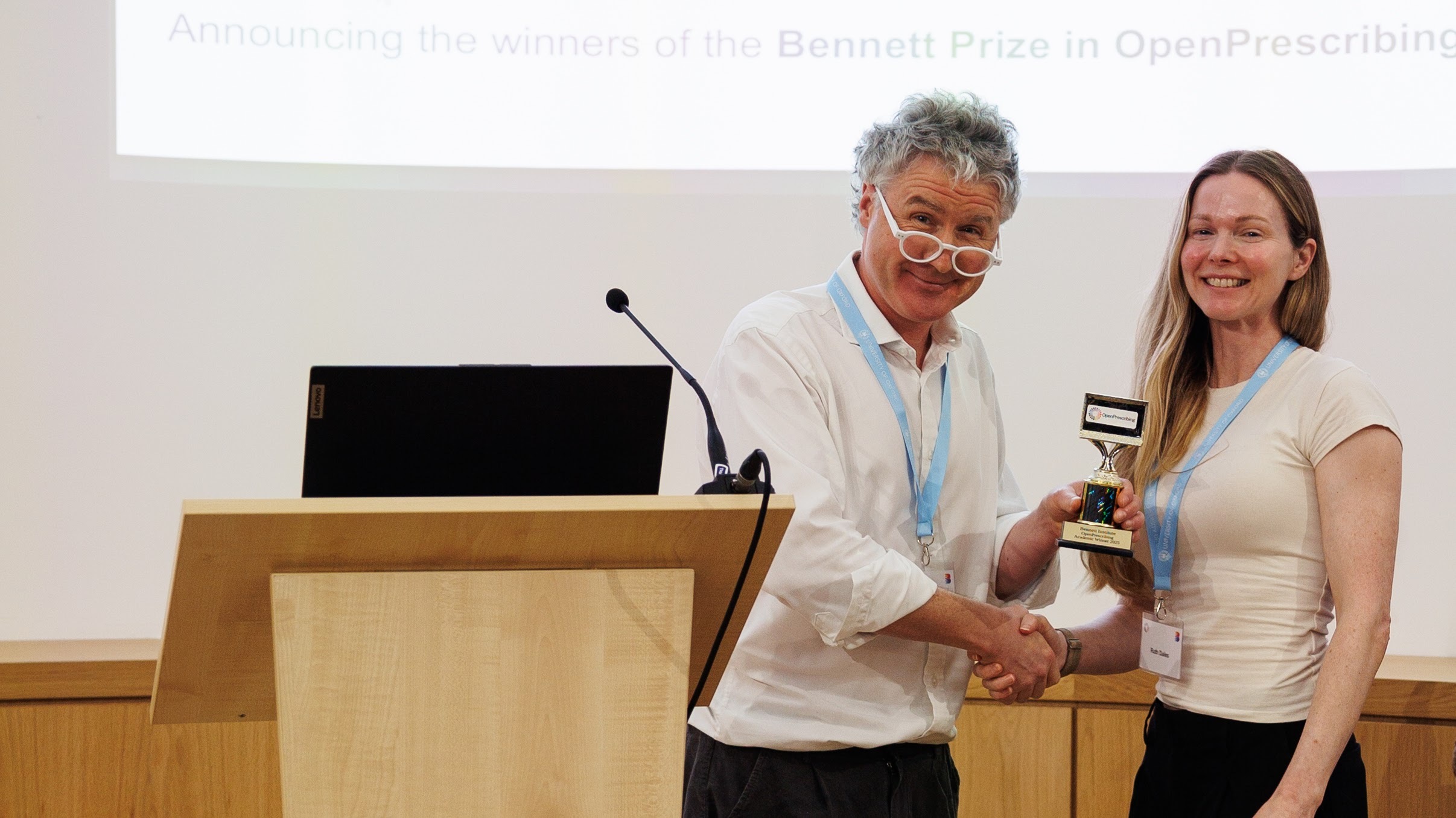
The Academic winners of the Bennett Prize in OpenPrescribing were Ruth Dales, James Innes, and Tony Jamieson, from the National Medicines Safety Improvement Programme Team, NHS England. The post below was written by Ruth Dales. James Innes was the project lead.
How the National Medicines Safety Improvement Programme (MedSIP) Used OpenPrescribing to Improve Methotrexate Safety Nationwide
By Ruth Dales
Some risks in medicines safety are well‑known but stubbornly persistent—the kinds of issues that remain in the system for years despite repeated guidance. Accidental overdose from oral methotrexate has long been one such problem. Although national advice recommends prescribing only the 2.5 mg strength tablets to avoid confusion with the visually similar 10 mg tablets, pockets of 10 mg prescribing continued across England.
This blog explains how the Medicines Safety Improvement Programme (MedSIP) worked during 2021–2022 to address this risk, using OpenPrescribing as a key source of data, and how the latest data to October 2025 shows these improvements have been sustained.
The Problem: A Persistently High‑Risk Practice
Despite repeated national guidance over many years, 10 mg methotrexate tablets were still being prescribed in some parts of England.
Analysis showed:
- 23% of integrated care systems (ICSs) accounted for 76% of all 10 mg methotrexate prescribing in England.
This made the issue significant yet targetable.
Targeting Variation Is Not New — But the Scale of Change Is
The NHS has long used prescribing variation data to identify opportunities for safer and more effective practice. That approach is familiar.
What’s new is the scale, consistency, and speed of improvement enabled by the MedSIP.
We achieved this through:
- accessible, transparent prescribing metrics (such as those available in OpenPrescribing)
- nationally co-ordinated network‑based delivery model that provided improvement coaching and facilitation and supported rapid shared learning across systems
- locally led improvement, enabling ICSs to tailor solutions to their own contexts
This combination allowed longstanding variation to be addressed at national scale.
How MedSIP Used OpenPrescribing to Support Improvement
This work used OpenPrescribing’s openly available data to understand, prioritise, and monitor prescribing behaviour.
1. Making unwarranted variation visible
OpenPrescribing helped us identify which ICSs were persistent outliers and assess how their prescribing compared with national.
2. Targeting support where it would have the most impact
Month‑by‑month data revealed where prescribing of 10 mg tablets was consistently high, Pareto analyses guided the formation of a focused support cohort in early 2021.
3. Supporting monitoring over time during the improvement period
ICSs used OpenPrescribing throughout the programme to track their progress, communicate improvement locally, and compare progress across regions.
4. Enabling ongoing quality management
Importantly, OpenPrescribing continues to provide local, regional, and national visibility of prescribing performance, allowing systems to maintain oversight, respond to changes, and embed continuous quality management long after the programme’s formal action period ended.
Enabling Local Innovation
Eight ICSs joined the targeted improvement cohort. Consistent with MedSIP’s approach, the programme supported local teams while allowing them to design their own solutions. These included:
- updating formularies and clinical system prompts
- reviewing local guidance
- strengthening pharmacy workflows
- using OpenPrescribing data to drive conversations and decisions
- sharing learning rapidly across the national network
The results were substantial:
- A 54% reduction in 10 mg methotrexate prescribing across the high‑prescribing ICSs, exceeding that of the remaining ICSs/CCGs.
- A significant narrowing of variation between high‑prescribing ICSs and the rest of England
- System‑level changes to support sustainability
This demonstrated what can be achieved when local improvement is supported by national coordination and accessible data.
Sustained Improvement: Latest Data to October 2025
The most encouraging finding is that the impact has lasted. OpenPrescribing data up to October 2025 shows that the reductions achieved during 2021–2022 have been sustained, with ICSs maintaining significantly lower levels of 10 mg prescribing.

This long‑term improvement reflects both MedSIP’s emphasis on building sustainable system changes and the role of OpenPrescribing in enabling ongoing monitoring and quality management.
Why This Matters
1. Improved patient safety
Reducing the availability of 10 mg tablets lowers the risk of accidental overdose.
2. A nationally scalable improvement model
MedSIP’s use of accessible metrics, nationally co-ordinated network‑based delivery, and locally led improvement creates a powerful model for addressing similar long‑standing safety challenges at scale.
3. Transparent data supporting system leadership
OpenPrescribing empowers local, regional, and national teams to identify risks, monitor progress, and sustain improvements over time.
4. Stronger safety culture and systems
By enabling rather than dictating action, MedSIP strengthens local capability and ownership of medicines safety.
Looking Ahead
This methotrexate project demonstrates what’s possible when national improvement expertise, open prescribing data, and locally driven action come together to tackle a high‑risk, long‑standing issue at scale. To read more, see our academic paper, “National quality improvement intervention to reduce high risk oral methotrexate prescribing”, published in BMJ Open Quality.
With MedSIP continuing to focus on the “big sticky issues” in medicines safety—and with tools like OpenPrescribing supporting continuous monitoring and improvement—the NHS is better equipped than ever to reduce harm from high‑risk medicines and strengthen safety systems across England.