


An OpenPrescribing prototype for exploring Hospital FP10s
- Posted:
- Written by:
- Categories:
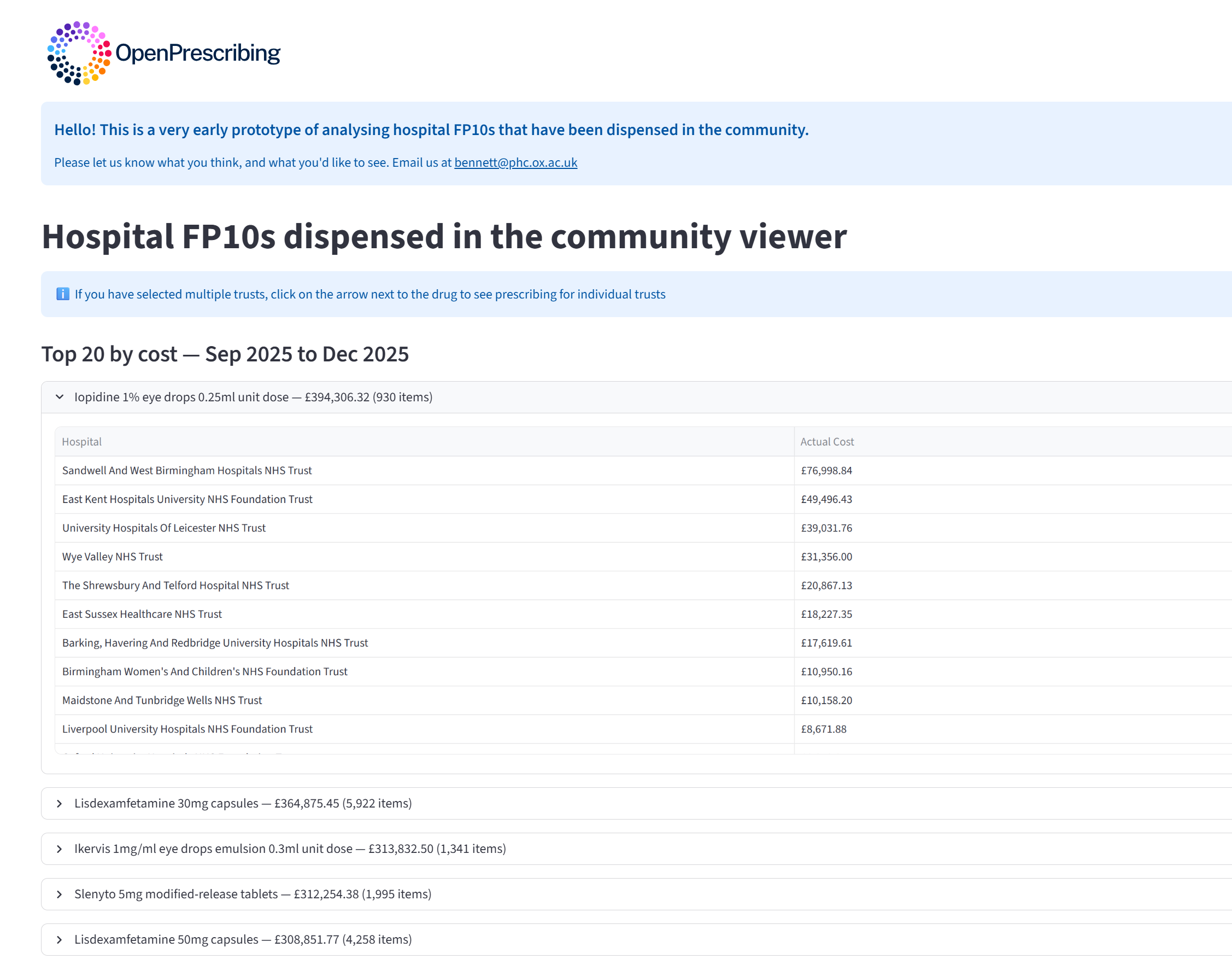
At the Bennett Institute we often build small quick prototypes to test our ideas before we commit to incorporating them into our fully functioning tools like OpenPrescribing.
Sometimes we get these ideas ourselves: all of us in the clinical informatics team have “day jobs” in the NHS. Sometimes we spot a gap in the data. Sometimes we want to just see if something is possible. But mostly we get our ideas from discussions with our users, through formal user testing as well as informal off-the-cuff conversations. We prefer to build in the open, rather than disappearing for months and returning with something polished.
This week’s example is our Hospital FP10s dispensed in the community tool.
What are hospital FP10s?
For the more casual users: an FP10 is the standard prescription form. You may have had your own “green prescription” from your GP, although 96% of these are sent electronically these days. Most of them are written by GPs but other NHS services, including hospitals, can issue them. They are often used by hospitals for outpatient prescriptions or urgent medicines when a hospital pharmacy is closed, allowing patients to take a prescription to their local community pharmacy.
Where did the idea come from?
The idea for the tool grew from conversation whilst user testing OpenPrescribing for Hospitals. Whilst visiting hospital pharmacy departments doing “learning@lunches”* and small group demonstrations we found that in nearly every single meeting a single voice would ask “but what about FP10 prescribing?”. Initially we weren’t sure about investing resources into this as FP10 makes up only about 1% of hospital medicines costs. However, as the questions were so consistent and similar , we decided to take a look.
*(Drop us an email if you would like us to do a learning@lunch session for your team!)
A deliberately quick prototype
Caroline started by doing some data discovery by importing the dataset into a Jupyter notebook. This allowed us to quickly look at what the dataset had, and what we could use it for. For example, we were able to see a gradual increase in the number of items prescribed by FP10 and that the extent of FP10 use varies considerably between organisations.


You can see the full notebook here.
Once we’d found out what the data contained we decided it was worth prototyping an interactive tool. Rich put together the first working version in a matter of hours. He used the open tools Streamlit and DuckDB, focusing on the core question “can we quickly allow our users to explore hospital FP10 prescribing in a quick way?” We then shared it with some people who had been asking the question and a few who hadn’t. Everyone has told us that it was incredibly useful and we have already iterated based on the feedback.
Why Streamlit?
We’ve been using Streamlit for a while now to prototype measures, and we’ve just started using DuckDB as a database (more on that another time!). Streamlit is an open source tool designed specifically to easily build apps for data analysis. A lot of the code needed to calculate the data and show the visualisations are already baked into the tool.
For example, to get the multiselect filter for BNF names, you can simply use the built-in function st.multiselect. Because a lot of these tools are baked in, it doesn’t take us long to play with our ideas, adding, removing and changing them quickly, and getting an instant change to play with.
Please use it and give us your feedback. That said, it is still a prototype. Things may break occasionally. Features may appear or disappear. It is deliberately rough. That’s the point.
We want to learn more before investing in incorporating it into OpenPrescribing.
What we want to learn
At this stage we’re interested in anything and everything:
- Is the data useful?
- Are there patterns you expected to see but didn’t?
- Is the interface helpful or confusing?
- What questions does it raise?
- What task might you use it for?
Early feedback is exactly what helps us decide what to do next.
If you have thoughts, questions, or ideas about the tool - please get in touch with us via email.
One of the best parts of working this way is that it lets us pool skills and perspectives across the community: clinicians, analysts, pharmacists, researchers, and developers all looking at the same data from different angles. Sometimes the most interesting ideas start as a quick prototype and a conversation. Hopefully this is one of those.