


Big data and better healthcare: inside the Bennett Institute's NHS data tools
- Posted:
- Written by:
- Categories:
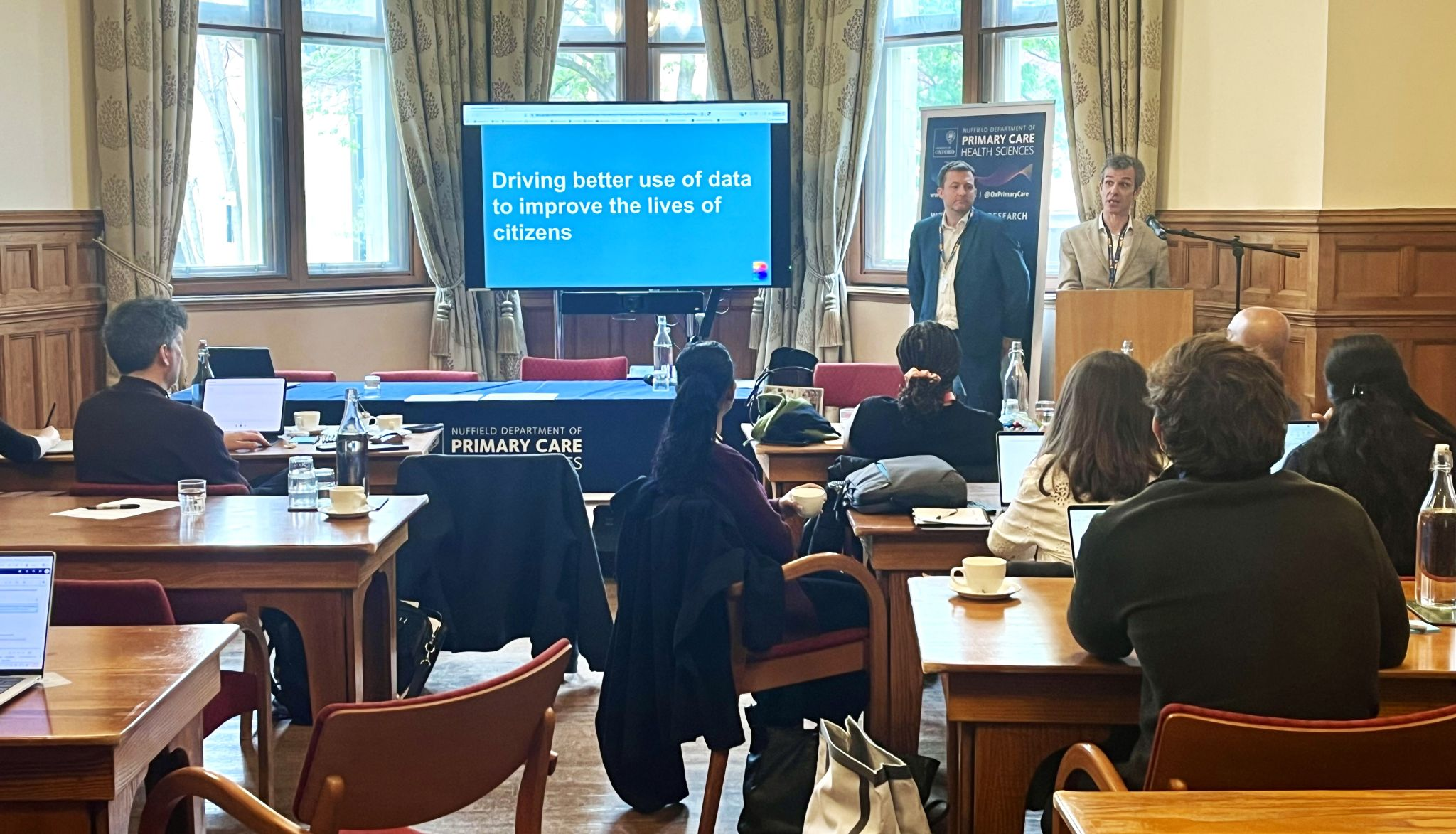
Every month, 20,000 unique users log into OpenPrescribing to view GP prescribing patterns – making it one of the most widely used data tools in English primary care.
At this week’s second ever Nuffield Department of Primary Care Health Sciences alumni retreat, the Bennett Institute’s Chief Technology Officer Seb Bacon and our resident pharmacist Brian MacKenna walked a room full of returning graduates through how tools like this are built, the impact of big data in healthcare, and what becomes possible when you can analyse them securely at a national scale.
The potential has long been recognised. What Seb and Brian showed the room was how the Bennett Institute has made it practical, secure, and efficient through two tools: OpenPrescribing and OpenSAFELY.
Understanding the Bennett Institute’s big health data tools: OpenPrescribing and OpenSAFELY
OpenPrescribing is an interactive, data-driven tool allowing users to explore NHS GP monthly prescribing behaviour across England, including data at the level of individual doses and brands, and individual drugs at individual practices.
With access to the search interface on the NHS Business Services Authority’s raw English Prescribing Dataset, over 20,000 unique monthly users visit OpenPrescribing to better understand and improve the quality, safety, and cost effectiveness of prescribing in their practice(s) and/or postcode.
OpenSAFELY, an award-winning secure analytics platform for electronic health records in the NHS, was developed in response to the COVID-19 pandemic in 2020, providing significant insight into factors associated with COVID-19-related deaths.
Delivering analyses across more than 58 million patients’ full pseudonymised primary care NHS records, the scale of OpenSAFELY provides huge analytical opportunities in the UK in terms of:
- Breadth: one record for every citizen
- Depth: detailed information on all GP contacts, diagnoses, tests, and more
- Research: causes of disease, prevention, treatment benefits, risks, uptake, and costs
- Improving NHS care: understanding variation in who gets treatments and where
Crucially, this is achieved in a way that maximises trust and efficiency: NHS England and GPs remain in control of the data, while researchers work at arm’s length using fully transparent, auditable code.
By keeping data locked down but code open, and by providing analysis-ready GP data, OpenSAFELY enables research that is transparent, trustworthy, efficient, and easy to use at scale.
Looking ahead: the future use of big data at the Bennett Institute
OpenSAFELY is currently expanding beyond its COVID-19 origins into broader areas of health research and analysis, including the analysis of NHS talking therapy outcomes, as well as linking to non-health datasets such as education, for example through OpenSAFELY Schools.
Applications are now open for researchers interested in using OpenSAFELY for non-COVID-19 studies, with NHS England accepting submissions until 30 April 2026 at 17:00.
Alongside this expansion, Bennett’s work will increasingly focus on making research more inclusive and globally impactful. As Seb noted, 90% of research only benefits 10% of the world’s population. We believe OpenSAFELY can help the global health research community move away from more extractive research models – where researchers from wealthier countries collect data in lower-income settings, analyse it at home, and publish the results with little benefit flowing back to the communities the data came from.
Ultimately, as Brian put it, while big data offers powerful new ways of understanding and improving global healthcare, it remains a tool – not a solution in itself. As its use continues to grow across clinical, academic, and research settings, it should complement – not replace – the insight and context that come from the interaction between clinician and patient, which remains the foundation of delivering meaningful care in a digital age.
To learn more about our work with big data, visit the Bennett Institute’s website, follow the Institute on LinkedIn and @bennettoxford.bsky.social (BlueSky), and sign up to receive notifications of the latest blog posts and newsletter updates.