


New OpenPrescribing Hospitals Antibiotics measures
- Posted:
- Written by:
- Categories:
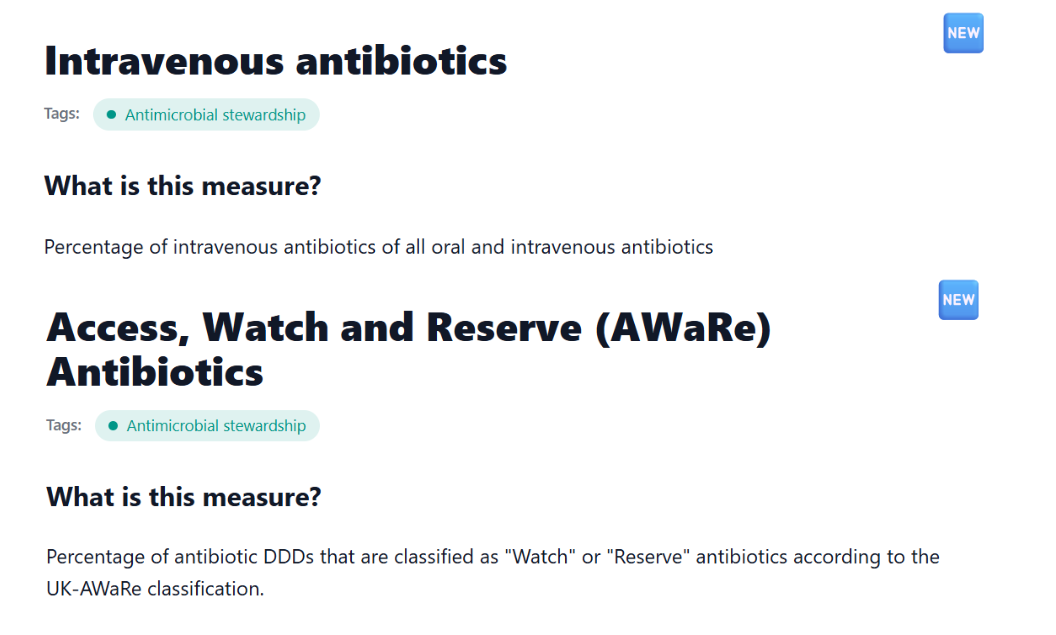
We’ve launched new measures to support antimicrobial stewardship in hospitals. They are already live - have a look at AWaRe and IV vs oral antibiotics measures for your organisation now!
Why focus on antibiotics?
Antibiotics play a critical role in modern medicine. They are widely relied upon for the treatment of bacterial infections and they are also used to prevent infections in high risk situations, for example during certain types of surgery. Bacteria can develop an ability to withstand the effects of the antibiotics used against them, known as antibiotic resistance. Inappropriate use and overuse of antibiotics is known to be a major factor in the development of antibiotic resistance. With a limited number of antibiotics available and only a small number in the development pipeline, the continued rise in antibiotic resistance poses a significant threat to human health.
Antimicrobial stewardship refers to the approaches used to promote and monitor judicious use of antimicrobials to preserve their effectiveness for the future. We can use OpenPrescribing Hospitals measures to support antimicrobial stewardship efforts by making data on some key antimicrobial stewardship areas readily available to clinicians and antimicrobial stewardship teams.
AWaRe categorisation measure

View Measure on OpenPrescribing Hospitals
The UK Health Security Agency (UKHSA) has developed the UK-AWaRe classification adapted from the World Health Organization’s (WHO) AWaRe classification. The UK adapted classification takes into account antibiotic resistance profiles, antibiotic prescribing and stewardship practice in the UK. The classification groups antibiotics into four categories to support appropriate prescribing and promote effective antimicrobial stewardship:
Access
Access antibiotics are those with a narrow spectrum of activity, fewer side effects, lower costs, and importantly lower resistance potential. These are first or second choice antibiotics recommended for empiric treatment of the most common infections and should be widely available. That is to say, these antibiotics should offer the best therapeutic value while minimising the potential for resistance.
Watch
Watch antibiotics have a higher resistance potential and are broader-spectrum antibiotics. These are first or second choice antibiotics indicated for a limited number of infective syndromes. As these antibiotics are considered to have a higher potential for selection of antimicrobial resistance (AMR), their use should be carefully monitored.
Reserve
Reserve antibiotics are “last resort” antibiotics, including new antibiotics. These are used for highly selected patients (life-threatening infections due to multi-drug-resistant bacteria) and are closely monitored and prioritised as targets of stewardship programmes to ensure continued effectiveness.
Other
Some antibiotics do not fit into one of these 3 classifications. For example those that are only used to treat very specific conditions. These are classed as “Other”.
The NHS Standard Contract requires that providers must “use all reasonable endeavours, consistent with good practice, to minimise its Broad-Spectrum Antibiotic Usage in accordance with the requirements of the National Action Plan for Antimicrobial Resistance”. Monitoring the use of “Watch” and “Reserve” antibiotics can help identify areas to improve prescribing, encouraging the appropriate use of “Access” antibiotics where clinically appropriate.
Intravenous vs oral antibiotics measure

View Measure on OpenPrescribing Hospitals
When treating infections in NHS hospitals, inpatients are often treated with intravenous antibiotics. Intravenous antibiotics can sometimes be used for longer than necessary. The UK Health Security Agency (UKHSA) highlight antimicrobial intravenous-to-oral switch as an important antimicrobial stewardship intervention and have produced a decision aid to support this process. They list a number of potential benefits of switching from IV to oral antibiotics where clinically appropriate:
- decreased risk of bloodstream and catheter-related infections
- reduced equipment costs, carbon footprint and hospital length of stay
- increased patient mobility and comfort
- released nursing time to care for patients
What isn’t included?
A small number of relevant antibiotics do not have a defined daily dose (DDD) assigned by the WHO. We list these antibiotics in the table “Products included in this measure” for visibility, but they are not included in the measure calculation.
Antimicrobial Stewardship in Primary Care
Don’t forget, we also have a series of measures and a recording of a previous webinar in OpenPrescribing looking at Antimicrobial Stewardship.
Conducting your own analyses
You can also use the analyse pages on OpenPrescribing and OpenPrescribing Hospitals to explore your own data. For example you might want to monitor how patterns of methenamine usage have changed across primary and secondary care. Please let us know if you find anything interesting, or have any ideas for additional measures.
Get in touch
As a small team of clinicians, academics, and software engineers, we are able to build and launch dashboards quickly by working in an agile manner, openly describing our methods and code. If you have any suggestions for further developments of our measures on OpenPrescribing or OpenPrescribing Hospitals please get in touch at bennett@phc.ox.ac.uk