

- Posted
- Categories
-
- OpenPrescribing
OpenFormulary: ahead of its time
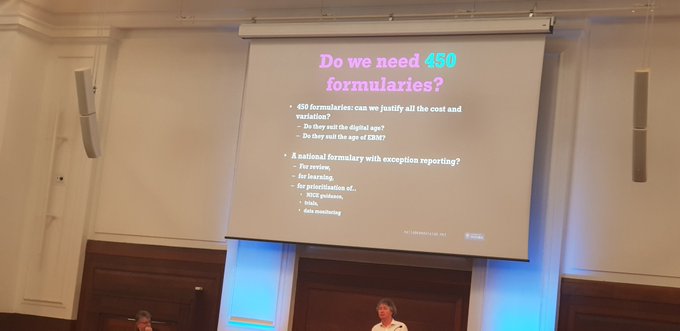
In 2019, we pitched a national tool to track local formularies. Now the NHS is doing just that! We’re sharing our plans and advice to help it succeed.
In 2019, we pitched a national tool to track local formularies. Now the NHS is doing just that! We’re sharing our plans and advice to help it succeed.

A summary of our discussion with NHS leaders on how Medicines Optimisation teams can leverage data science to enhance their strategic capability.

Bennett research integrity lead, Nick DeVito, on the encouraging words about code sharing that Kamran Abbasi delivered at our recent OpenSAFELY Community Symposium.

Details on two new papers from the Bennett Institute Research Integrity Team.

The first session in the Bennett Conference discussed past and present work of the Institute on research integrity and policy issues.

The Clinical Trial Information System (CTIS) is the European Union’s new registry set to fully replace the existing EU Clinical Trials Registry next year. Nick DeVito decided to take a spin through the registry and record some of his initial thoughts.

In June 2022, the NHS published its new data strategy Data Saves Lives. The strategy is a broad ranging document, covering seven ‘key areas’.

Building a strong case for the broader adoption and use of Trusted Research Environments across the NHS.

An overview of the UK Government’s nine data policy documents published April - July 2022.

Today the NHS has published the final version of it’s “Data Saves Lives” strategy, setting out its key commitments in seven key areas
Over the past year Ben and our policy lead Jess, have conducted interviews with over 300 individuals, held 8 open focus groups, reviewed over 100 written submissions, and conducted extensive desk research, to reach the conclusions that were published yesterday in the Goldacre Review.

This week sees the publication of an independent Citizens’ Jury commissioned for NHSx and the National Data Guardian which found that OpenSAFELY was by far the most strongly and consistently supported of all NHS COVID data projects examined.

On our first anniversary, from the Policy Lead in the Bennett Institute, this is the brief story of the positive side from all our lives: how OpenSAFELY came to life, and what we’ve achieved so far.

This is a draft discussion paper, the first of a series exploring “open team science” approaches to managing health data, and specifically how to create a collaborative computational data science ecosystem where the sharing and re-use of objects such as codelists and code is facilitated, encouraged, recognised, and rewarded. As a microcosm of this we have first explored “codelists”. There are currently no ‘answers’ or preferred solutions given. We will be holding an open discussion with the research community on 2nd March at 3pm - you can book to join us here.
New hospital medicines data, plans for OpenPrescribing Hospitals, research on clinical software design, and an oral morphine equivalence update.

In July, Ben and Brian wrote a piece in the British Medical Journal arguing that hospital medicines data should be openly shared. Magnificently, the NHS has now made secondary care medicines data (SCMD) available. You can read the full technical specification of the data here but briefly: it is hospital pharmacy stock control data, which is collected and processed by Rx-Info, and is now published on the NHS Business Services Authority website in the NHS dm+d standard we know, love, and have documented well.

Working on behalf of NHS England we have now built a full, open source, highly secure analytics platform running across the full pseudonymised primary care records of 24 million people, rising soon to 55 million, 95% of the population of England. We have pursued a new model: for privacy, security, low cost, and near-real-time data access, we have built the analytics platform inside the EHR data centre of the major EHR providers, where the data already resides; in addition we have built software that uses tiered increasingly non-disclosive tables to prevent researchers ever needing direct access to the disclosive underlying data to run analyses; code is developed against simulated data using open platforms before moving to the live data environment. Everything has run smoothly. We are fully live inside TPP; we are signed off with full data access and end-stage tech development for the computational platform with EMIS.
New papers on hospital medicines data, NHS analytics and statin prescribing, alongside updated CCG dashboards and OpenSAFELY COVID-19 research.
New research on unsafe methotrexate prescribing, bespoke prescribing email alerts, and analysis of COVID-19’s impact on prescribing in March 2020.
Introducing OpenSAFELY, COVID-19’s early impact on prescribing, rising price concession costs, and bespoke PCN email alerts.
Covid-19 shows that we must overcome organisational barriers to deliver clean, realtime, standardised data in support of direct care, system planning, and urgent response

Most people share their end of year roundup during late December when everyone is too full of cake to read. Now you’re back in the saddle, here’s our roundup of everything the Bennett Institute threw out into the world over the previous 12 months!
OpenPrescribing.net went from strength to strength, with over 135,000 unique users last year. We now have over 80 measures of prescribing safety, efficacy and cost-effectiveness and have been working on new types of measures and alerts to identify “outlier” prescribing, such as with zuclopenthixol. In 2019 we also: launched new dashboards and bespoke alerts for every single primary care network (PCN), sustainability and transformation partnership (STP), and NHS region; upgraded the Analyse page to support more organisations with bespoke medicines queries; and developed tools to help solve the problem of Ghost Branded Generics which cost the NHS an extra £11.6million per annum but has massively reduced during 2019.
PCN dashboards go live, research examines clinical software and prescribing safety, and a guest blog explores high-dose dexamethasone.

Our EU TrialsTracker has been assessing compliance with EU trial reporting guidelines for over a year now. Our data has been used by Parliamentary Committees and trial sponsors to improve the reporting of clinical trials registered on the EU Clinical Trials Register (EUCTR).
We previously shared some of the data issues that make complete assessments of trials on the EUCTR difficult. One particularly troubling issue is dealing with trials that never began. Sometimes trials get all the necessary approvals to begin, and therefore are automatically registered on the EUCTR. In rare instances, and for any number of reasons, they then simply never begin; they are cancelled before they enroll a single participant or collect any data. Obviously, these trials have no results to report.

Last week, the Commons Science and Technology Select Committee convened an inquiry following-up their previous clinical trials transparency efforts. The Select Committee has been very active in the trials transparency space over the past two years. Earlier this year they sent letters to every public university and NHS trust in the UK that sponsors clinical trials on the EU register. These letters reminded sponsors of their trial reporting responsibilities and provided them with reporting performance figures based on data from our EU TrialsTracker.
New inhaler environmental impact and seven-day prescribing measures, research on prescribing changes, and expanded data downloads.
Links from prescribing measures to the Analyse page, improvements to the price-per-unit savings tool, and preparations for PCN dashboards.
The launch of the NHS dm+d browser, lower thresholds for price-per-unit savings, and price concession dashboards for STPs and regional teams.

Earlier this year we noticed a disturbing trend among UK trials registered on the EUCTR. The amount of newly approved and registered trials on the EUCTR dropped drastically following the 2016 Brexit vote. The chart from that blog post (from May 2019) is included below.
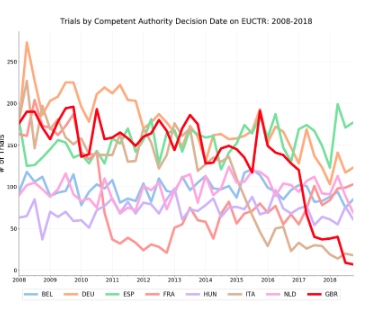
When we reached out to the MHRA to ask about this, they stated that there was actually no decline in UK trials post-Brexit but rather administrative delays that kept trials from appearing on the public-facing EUCTR website. They noted this issue was being addressed and updates would be completed by the end of Q2 2019.
New low-priority prescribing measures and All England email alerts, alongside Analyse page improvements and plans for Primary Care Network dashboards.
Research on variation in adopting UTI prescribing guidance, user testing for regional and STP dashboards, and preparations for newly merged CCGs.

We recently noticed a very dramatic drop in the number of UK clinical trials post-Brexit on the EU Clinical Trials Register (which would be a catastrophe for British science) and wrote to MHRA to get their view. It turns out that the drop is largely due to bad data management: this is worrying, but not the same thing as a drop in the number of UK clinical trials.
We’ve been conducting research on trends in clinical trials globally with one very striking recent finding: examining clinical trials on medicinal products, using the EU Clinical Trials Register (EUCTR), the number of trials with a competent authority decision from the UK has fallen dramatically. As you can see on the graph below: from a long-term trend of around 150 new trials per quarter, after 2016 there is a rapid drop to fewer than 50, and now fewer than 10.
New price concession email alerts, a guide to finding prescribing cost savings, and improvements to measure breakdowns and Analyse page totals.

As you know, here at the Bennett Institute we are working on the RetractoBot project to reduce the number of cited retracted papers.
Citations of retracted RCTs are particularly dangerous because such trials provide strong and unbiased evidence of treatment’s safety and efficacy (hierarchy of evidence). Moreover, results of RCTs are often pooled in systematic reviews and meta-analyses, which are used to synthesise the available evidence on a given subject or to justify clinical guidelines.

Now that we’ve launched our FDAAA TrialsTracker, we plan on occasionally taking a closer look at some of the trials that go unreported. Our first blog was about a trial examining 2 drug combinations for managing pain during labor (NCT01846221).
So why do we think this specific trial is due to report? While we go through how we established our criteria and set up our database in detail in our preprint paper on Biorxiv, we wanted to walk you through exactly what fields matter on ClinicalTrials.gov and how we used them to build our tracker. We think we were able to do this well, but are open to feedback and will amend our paper and methods as necessary.

At OpenPrescribing, we provide tools for analysing prescribing behaviour in primary care in the NHS in England. If you work with prescribing data, you may have noticed that practices which are “dormant” apparently continue to prescribe. This short article explains why, for the curious.
Our prescribing data comes from the NHS Business Services Authority (NHSBSA), who are responsible for processing dispensing information supplied by pharmacies. Each line of the data includes a practice code which uniquely identifies the GP Practice that issued the prescription. To understand more about each practice (including its contact details, location, and CCG membership), we cross-reference this code with GP Practice data published by NHS Digital. That data contains a column, status, which sometimes contains the value D, for dormant.